A language
made of flavour.
Ganesh Bagler on computational gastronomy, the grammar of cuisines and AI in the kitchen
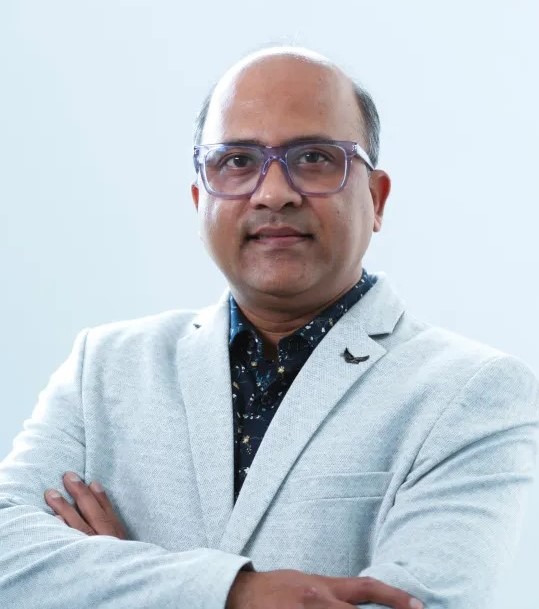
Ganesh Bagler
Computational gastronomy researcher · IIIT-Delhi
In conversation with Holger Nauheimer
With an appearance by Nyx
A pot of dal. A world of recipes. A question about the rules we follow without noticing. Ganesh explores what food can reveal when we look for patterns — and what a computer still has to learn about dinner.
Listen to the episode
Before the data,
there was a dinner table.
Ganesh Bagler did not arrive at food research through a lifelong ambition to cook. He grew up in a part of India where scarcity was familiar, and where the rule at home was simple: finish what is on your plate. His mother cooked. Years later, scientific curiosity led him towards the kitchen.
That curiosity became computational gastronomy: an approach that studies food through data, algorithms and questions about how we cook. Why do some ingredients so often appear together? Can a cuisine have a recognisable fingerprint? And what happens when a computer learns from the recipes people have passed down?
Our conversation moves between the scale of a recipe database and the intimacy of a familiar meal. We discuss the limits of English-language sources, the complications of calling a dish Indian or Ukrainian, and Ganesh’s proposal that cuisines have something like a grammar.
When Nyx joins us, the idea meets an actual dinner Holger is planning to cook. Later, a memory of sushi in Bangkok raises another question: how much of a chef’s knowledge can be described, and how much emerges only through practice?
“Let us not forget that AI is not a magic potion.”
Ganesh Bagler · From the conversation
Show notes
The rules we inherit.
The meals we invent.
A guide to the conversation.
Why do we eat what we eat?
Ganesh begins with a question that has many answers: hunger, pleasure, nutrition and the histories we bring to the table. He recalls growing up where scarcity shaped his family’s attitude to food.
Rice, dal and a little asafoetida
Research drew Ganesh into cooking. At home, the food remains simple: rice, dal and vegetable dishes. Asked for a dal tip, he points to the balance of lentils and water, seasoning and a little asafoetida.
The patterns inside a cuisine
From food-pairing hypotheses to culinary fingerprints and a world cuisine tree: Ganesh describes how recipes and flavour molecules can reveal patterns in the ways ingredients are combined.
Teaching a computer to read a recipe
RecipeDB and FlavorDB help turn food knowledge into data. Ingredients are only part of the picture: quantities, preparation, cooking actions, utensils, temperature and time also matter.
What the data leaves out
English-language sources make a starting point, but leave gaps. Holger and Ganesh discuss regional knowledge, handwritten recipes and the difficulty of assigning a dish to one cuisine.
Does cooking have a grammar?
Ganesh proposes an analogy between cuisines and languages. Holger asks how that idea relates to chefs who cross boundaries, and Nyx joins them to put the question to a kitchen test.
A recipe on paper. A meal on a plate.
Ratatouille generates recipes; the Turing Test for Chefs asks professionals to judge them. We discuss what reading a recipe can tell us, and why cooking and tasting it are different tests.
The skill that is hard to put into words
A sushi dinner in Bangkok opens a conversation about touch, practice and subtle decisions. Can the knowledge of an experienced cook be captured in data?
Food for a future we want to eat
Nutrition, sustainability and culturally acceptable food bring the discussion back to people. Ganesh names a favourite dish: Baingan Bharta, made with aubergine roasted over a flame.
The encounter
A familiar dish.
A small act of rebellion.
Holger has dinner plans. Nyx has a suggestion. Ganesh has a question about what, exactly, would have to change before a familiar dish begins speaking another culinary language.
Listen to their exchange in the episode.
The guest
Meet Ganesh Bagler.
Professor Ganesh Bagler leads the Complex Systems Laboratory at IIIT-Delhi. His research in computational gastronomy brings data science and artificial intelligence to questions about recipes, flavour, nutrition and food culture.
His team’s resources include RecipeDB and FlavorDB, alongside tools for exploring and generating recipes. In this conversation, he brings a scientist’s interest in patterns together with questions that belong to every kitchen: what do we eat, why do we combine it this way, and how might we cook differently?
Ganesh at IIIT-DelhiExplore further
Links & references.
Ganesh Bagler ↗Official faculty profile · IIIT-DelhiComplex Systems Laboratory ↗Research, publications and food-data resources · Ganesh’s labRecipeDB ↗Structured recipe data · Research resource discussed in the episodeFlavorDB ↗Food ingredients and flavour molecules · Research resourceRatatouille ↗AI-based recipe generation · Research toolFood mentioned in the conversation: rice, dal, vegetable dishes, flatbread, borscht, modak, Spätzle with lentils and smoked tofu, chicken with spinach, sushi and Baingan Bharta. Asafoetida, white miso, ginger and rice vinegar also enter the discussion.
Also discussed: food pairing, culinary fingerprints, the grammar of cuisines, gaps in recipe data, the Turing Test for Chefs and the difference between generating a recipe and cooking a meal.
From the conversation to the kitchen
Baingan Bharta.
A little fire. A lot of flavour.
Asked what he most loves to eat, Ganesh names aubergine roasted over a flame and cooked with spices. Our kitchen starting point brings that idea together with onion, tomato, ginger and a little chilli.
The related question
Can your hands know something
your brain doesn’t?
A sushi chef shapes rice with movements refined through years of practice. What does that tell us about the knowledge we can explain — and the skills that words alone cannot teach?
This episode features Nyx, Holger’s AI collaborator, speaking with a synthetic voice.
Stories Beyond the Podcast
Your turn
What’s your story?
Is there something your hands know in the kitchen that you find difficult to put into words? How did you learn it?
hello@nevertastedatomato.com
Your reply is private. We’ll ask for your permission before sharing your words, name or voice.